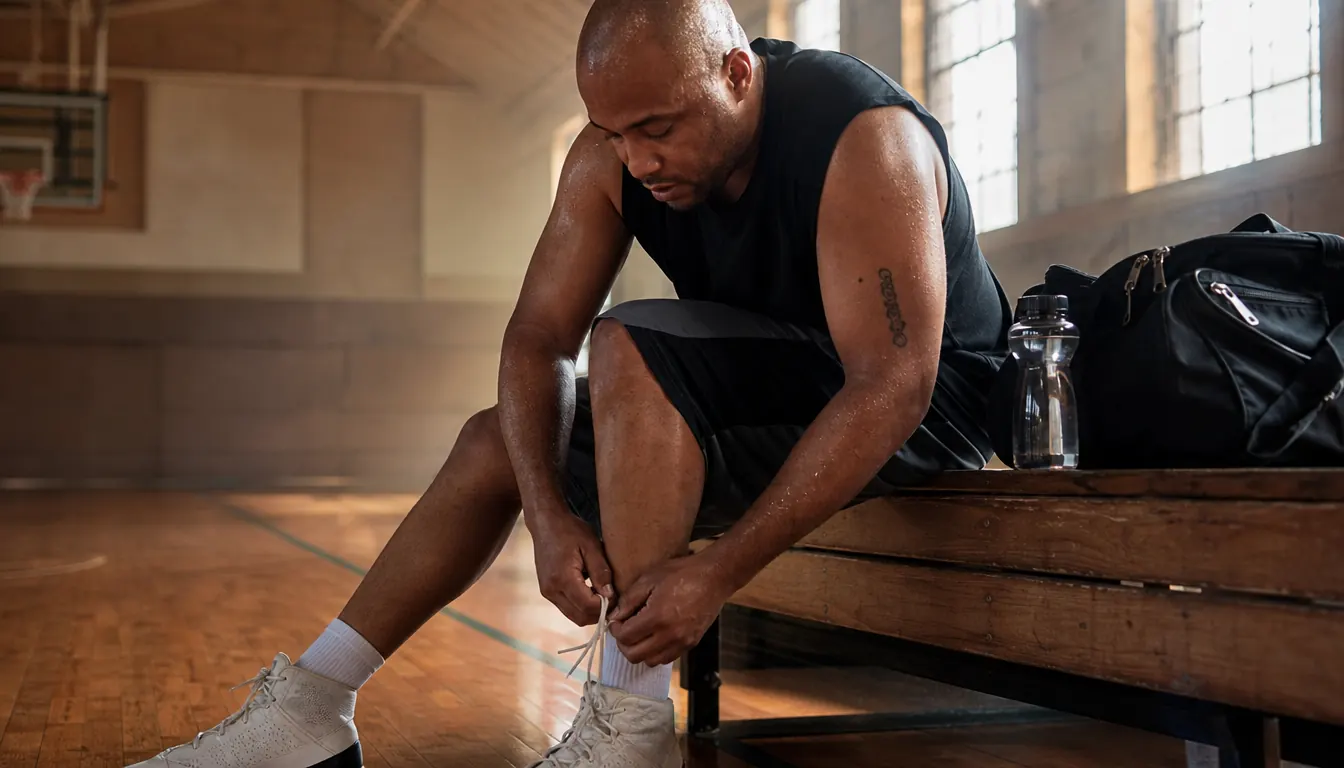
For about twenty years I bought basketball shoes the same way most grown men do. I walked into a store, asked for a 12, felt the pinch across the ball of my foot, and told myself it would break in. It never broke in. I just stopped noticing it until the fourth game of the night, when my forefoot would go numb and I'd start favoring the outside of my foot on cuts without deciding to.
I'm 47, six foot one, about 205 pounds, and I play guard and wing. My feet are a men's 11.5 with a slightly wide forefoot. Not a medical problem, not a diagnosis, just a foot that has never been happy in a shoe built around a narrower last. About fourteen months ago, in September 2025, I bought a pair of FitVille Wide Basketball Shoes in the extra-wide width to wear in the Sunday morning men's league at the church gym, where we play two games back to back. Before that I was playing in an old pair of standard-width cross-trainers. This is what fourteen months of Sundays has taught me.
The Quick Verdict
The first basketball shoe I've owned where my forefoot stops being the thing I think about. Ankle support is real, traction is good on clean hardwood, and the tradeoff is a stiff shoe that feels heavy on the first few wears.
Amazon Check Today's Price →If your forefoot has never fit a standard shoe, start here
Extra-wide width, high-top collar, foam insole, lace-up closure. The shoe I've worn every Sunday for fourteen months. Check the current price and available widths on Amazon.
Amazon Check Today's Price on Amazon →How I've Used It
My week has a fixed shape. Tuesday night pickup at the neighborhood rec center in one pair, Thursday night in another, Sunday morning men's league in the FitVille. That's roughly once a week in this shoe for fourteen months, two full games each time, on a church gym floor that gets swept maybe once a month. I've also worn it through a handful of summer mornings at the park court near my house, though asphalt is not where it lives.
Two games back to back is a specific kind of test. It's not a forty-minute burst. It's ninety minutes of stop-start running with a fifteen-minute gap in the middle where your feet swell slightly and the shoe either gives you room or doesn't. That middle stretch is where I learned the most about this pair, and it's the reason I stopped rotating it into shorter runs.
Here's how I came to that split, because it wasn't the plan. When the FitVille arrived in September 2025 I fully intended to make it my everything shoe and leave the old cross-trainers in the garage. I wore it to a Thursday night rec center run that first week. The floor there is shorter and the runs are more sprinting than sustained half-court sets, and by the end of the night I could feel the stiffness in the shoe working against me rather than for me. It wasn't hurting. It was just not helping. So I put it back on the shelf until that Sunday, played two games in it, and knew immediately that this was the job it wanted. Sunday games, long sets, a lot of standing and cutting and landing. Thursday went back to a lighter pair and has stayed there ever since.
I wear a lace-up ankle brace on my left ankle, the one I rolled badly about ten years ago, in every game. That brace goes inside this shoe the same as it goes inside everything else I play in. If you wear a brace, you know the shoe has to be sized around it. I'll get into that below, because it's the single most useful thing I can tell another rec player.
The Forefoot Room Is the Whole Point
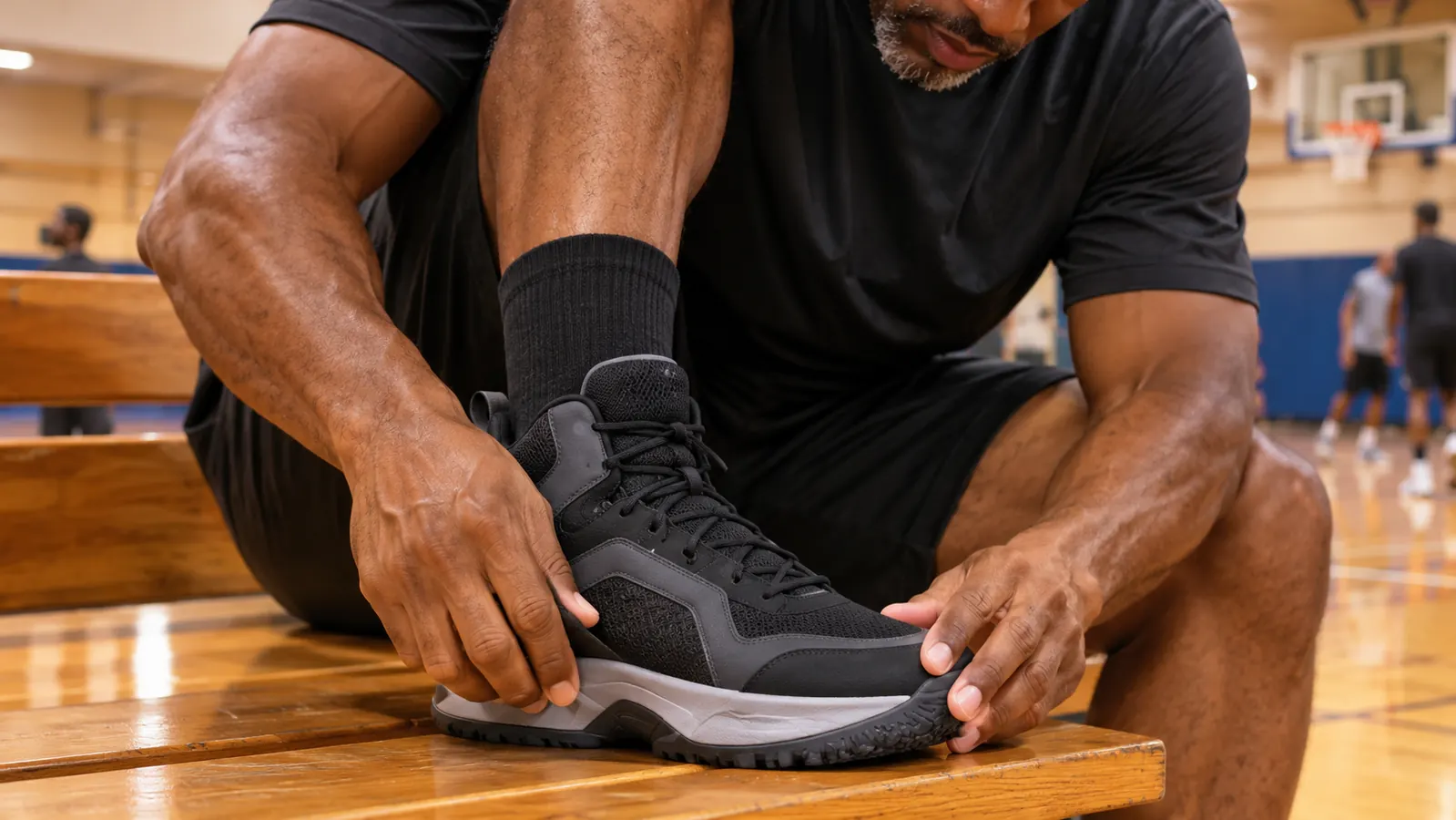
Here's what actually changed. In a standard-width shoe, my forefoot would start talking to me around the second game. Not pain exactly, more like constant awareness. In the FitVille extra-wide, that awareness is gone by the second wear. My toes spread out when I land and I can push off the ball of my foot without the upper pressing down on the outside edge.
The shoe is a high-top with a lace-up closure, and the lacing runs far enough forward that I can leave the bottom two eyelets looser for the forefoot and still lock the midfoot down tight. That combination is what makes it work for me. A wide toe box with no way to snug the midfoot would be a different problem, a sloppy shoe. This one lets me split the difference, room up front, snug through the arch.
Getting the lacing right took me longer than I expected, and I want to save you the weeks I wasted. For the first month I laced these the way I lace everything, pulling every row to the same tension from the bottom up. That felt fine standing still and wrong the moment I ran. What finally worked was leaving the bottom two eyelets completely slack, snugging the third and fourth, then pulling hard on the top three to set the collar. Standing still it feels slightly loose in the toes, which is the point. Once I made that switch, somewhere around late October, the pinch I'd been chalking up to break-in disappeared in one session.
The insole is foam, and the cushioning is what I'd call moderate to high. Underfoot it's soft enough that the second game doesn't feel like punishment, but not so soft that I lose the floor. I can feel the hardwood through it. For a 205-pound guard that's the right balance. I've played in pillowy shoes that made my knees happier and my cuts slower, and I didn't want that again.
By the fourth game of a Sunday doubleheader my forefoot used to be the loudest thing in my body. Fourteen months in this shoe, I forget I have a wide foot until I put on something else.
Ankle Support After a Bad Roll Ten Years Ago
I rolled my left ankle badly about a decade ago, and it changed how I buy shoes forever. I don't need a shoe to be a cast. I need it to hold the heel in place and keep the collar from folding over when I come down on somebody's foot.
The high-top collar on this FitVille sits higher than the low-cut shoes most rec players wear now, and it's padded enough that it doesn't dig into my achilles. The heel feels locked. On a hard cut to my left I don't feel the foot sliding inside the shoe, which is the thing that actually causes rolls. The collar adds a little resistance when I first put it on, and I've come to like that. It feels like a seatbelt.
The clearest test came in a game this past February. I went up for a rebound in the second game of a Sunday doubleheader, came down half on the edge of another player's foot. Ten years ago that exact landing is how my ankle got rolled. This time the collar held, the heel stayed put, the brace did its part, and the ankle never turned. I was annoyed for about a minute and then I kept playing. I want to be careful here, because this is where shoe reviews usually oversell. A high-top does not prevent ankle injuries. Nothing does. What I can tell you is what I've experienced: I wear a lace-up brace inside it, I've played roughly once a week for fourteen months, and I have not rolled an ankle in that stretch. I also hadn't rolled one in the years before, once I started wearing the brace. The shoe is part of a system with the brace, not a replacement for it.
Traction, Cushioning, and How It Feels in Game Two
Our church gym floor is dusty. You can see the swirl marks from the sweeper and the little gray patches where the finish has worn through. Traction there is good, not telepathic. I get a small chirp on hard stops and I don't slide out on lateral pushes. On a freshly swept floor it's noticeably better, which tells you the shoe's grip is fine and the floor is the variable.
The cushioning holds up across a doubleheader better than I expected from a foam insole. There's no point in game two where I feel like I'm standing on a board. It does compress some over the course of ninety minutes, and by the end of the second game the shoe feels a half step firmer than it did at tip-off. That's normal for foam and worth knowing if you're heavier than me.
The worst floor I've played these on was the first Sunday in March, the morning after a middle school tournament the night before. Nobody had swept between events and the boards had that dull gray film over them, the kind you feel before you see it. I had one bad slide out on a closeout in the first half of game one, and after that I adjusted, shorter steps, less commitment on the contest. That's the honest picture. The shoe does not grip a genuinely dirty floor clean. What it does is give you enough warning to feel it under you, which is more than I can say for a pair of old cross-trainers I used to own that just let go.
What surprised me most is how little my feet swell into discomfort. The extra-wide forefoot means there's somewhere for the swelling to go. In my old standard-width cross-trainers, the same ninety minutes would leave me unlacing in the car before I drove home. Now I drive home in the shoes. For the first three months I kept a pair of flip-flops in the car out of habit and never once used them.
The Tradeoffs Nobody Mentions
This is not a fast shoe. It's stiff out of the box, and it took me three or four Sundays before the upper stopped feeling like it was made of something folded. If you're the kind of player who wants a shoe to feel broken in the moment you put it on, you'll be annoyed for a month.
It's also heavier in the hand than a low-cut guard shoe. I noticed it most in the first ten minutes of a game, then stopped noticing it entirely. But I'm a 47-year-old rec player, not a 22-year-old trying to stay in front of a college kid. If pure quickness is what you're shopping for, this isn't the shoe. If you want to finish a Sunday doubleheader without your feet filing a complaint, it is.
One more: these are not water resistant. That sounds obvious for a basketball shoe, but I play outdoor summer mornings at the park, and dew on asphalt will soak straight through. If you're going to use them outside, do it in the afternoon.
What I Liked
- Genuinely wide through the forefoot, in an extra-wide width that most basketball shoes don't offer
- High-top collar and a locked-in heel that hold up on hard cuts
- Foam insole with moderate to high cushioning that survives two games back to back
- Lacing runs far enough forward to keep the midfoot snug while leaving the toes loose
- Held up through fourteen months of weekly play with no structural failure
Where It Falls Short
- Stiff for the first three or four wears
- Noticeably heavier than a low-cut guard shoe
- Not water resistant, so outdoor morning play in dew is out
- Takes deliberate lacing work to get the forefoot and midfoot tension right
Sizing Around an Ankle Brace
I wear the brace on my left ankle in every game, so this matters. I bought my usual men's 11.5 in the extra-wide width, and with the brace on, the left shoe is snug through the midfoot but not tight. The forefoot room is what saves it. If the toe box were narrower, the brace would push my foot forward into the front of the shoe and I'd be losing a toenail by November.
If you wear a bulkier brace than mine, or a thick sock plus a brace, I'd think hard about whether the extra-wide already gives you enough or whether you need to go up. I didn't need to. My advice is to lace it with the brace on the first time you try it, not after. I made that mistake with a pair years ago, sized the shoe on a bare foot in a store, and spent a season regretting it. It's a two-minute thing that saves you a return shipping label.
Who This Is For
This shoe is for the adult rec player whose forefoot has never fit a standard basketball shoe and who is tired of paying for shoes that only feel right in the store. It's for the guy who plays two games on a Sunday and drives home with his feet aching. It's for players who care about ankle support, either because they've rolled one or because they're old enough to start thinking about it. And it's for anyone who wants one pair of indoor shoes that will last a few seasons of weekly play without falling apart.
If you're shopping for a teenager who plays competitively and cares what the shoe looks like on the court, this probably isn't the pair. My son Jalen is 15 and plays JV, and when we've looked at shoes together he goes straight for the lighter, lower, more recognizable stuff. I get it. He's 15. His feet aren't mine yet.
Who Should Skip It
Skip it if you want a low-cut shoe. Skip it if you're a lighter, quicker guard who has never had a width problem, because you'll be carrying extra shoe for no reason. Skip it if you play mostly outdoors on asphalt, since the shoe isn't water resistant and the cushioning will break down faster on concrete than on hardwood. And skip it if you need a shoe that feels broken in on day one.
One more group: anyone who wants the shoe to fix an ankle. It won't. It's a high-top with a locked heel and it pairs well with a brace, and that's the honest extent of it. If you've got an ankle that's already unstable, talk to someone who knows more about it than a guy at the rec center.
Where It Fits in My Rotation
The FitVille is my Sunday shoe, and it has stayed my Sunday shoe. Two games back to back is the hardest thing my feet do in a week, and this is the pair that handles it. My Thursday and Tuesday shoes are lighter and quicker for the shorter rec center runs. That split has held for over a year and I don't see a reason to change it.
Fourteen months in, the shoe is still in use. No blowout, no sole separation, no collapsed collar. The insole has compressed where I push off, and the upper has softened into my foot. There's a scuff across the outside of the right shoe from a game in December that I've never bothered to clean off, and the laces are the original ones, a little fuzzy at the tips but still holding. If you want to know what a shoe is really like, ask somebody who's still wearing it a year later. I'm still wearing mine.
If you're weighing this against a standard-width shoe, the honest answer is that the width is the entire argument. Everything else about this pair is competent. The width is the thing you can't get anywhere else at this level, and if you need it, you'll feel the difference the first time you push off.
Fourteen months, one pair, still lacing up on Sundays
Extra-wide width, high-top ankle coverage, foam insole, lace-up closure. The shoe that made my forefoot stop being the story. Check today's price and sizing on Amazon.
Amazon Check Today's Price on Amazon →