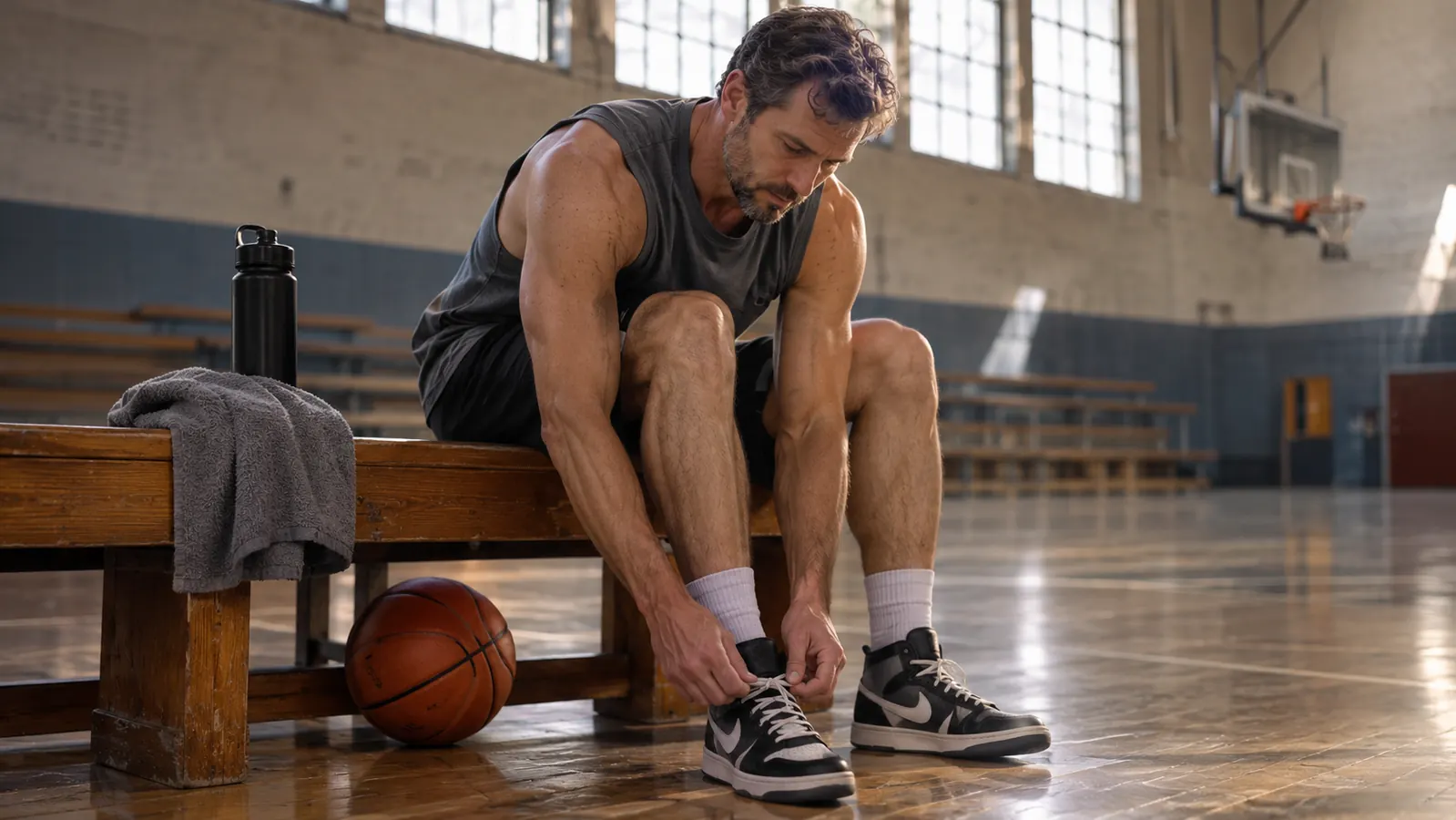
Every guy I play with has an ankle story. Mine is about ten years old. I came down on somebody's foot on a Tuesday night at the rec center in Columbus, on a floor that was dusty in the way that makes every cut feel like a guess, and my left ankle rolled before I understood what had happened. Six weeks on the couch. I watched a lot of bad television and thought about what should have been on my foot.
Most rec players have a version of that story, which is why the answer should be more obvious than it is. For years afterward I did what everybody does. I tied my shoes tighter, which does nothing for a joint. I wore a pull-on compression sleeve for a long stretch, and it felt good on a stiff morning, and it never once stopped the roll. I taped the ankle a few times and got it wrong more often than right, because tape is only as good as the guy wrapping it at 6:45 on a Thursday with seven minutes to tip. What actually changed how I play is a McDavid lace-up ankle brace on the left ankle, every game, inside whatever shoe I happen to be wearing that night. I bought it in December of 2025. I have not played a game without it since, and I have not rolled that ankle since either.
The one piece of gear I stopped thinking about eleven months ago
It goes on the left ankle before every Tuesday, Thursday and Sunday game. It is the only thing in my bag that never comes out.
Amazon Check Today's Price on Amazon →Step 1: Know what a lace-up brace does that a sleeve does not
An ankle rolls when the foot turns inward past what the joint will tolerate. It happens in a fraction of a second, almost always on the landing, almost always because somebody else's foot is where yours was supposed to come down. A compression sleeve wraps the joint and holds warmth in, and that has real value on a cold morning. What it is not built to do is resist the inward turn. That is the entire difference, and it is the reason I switched after years of telling myself the sleeve was enough.
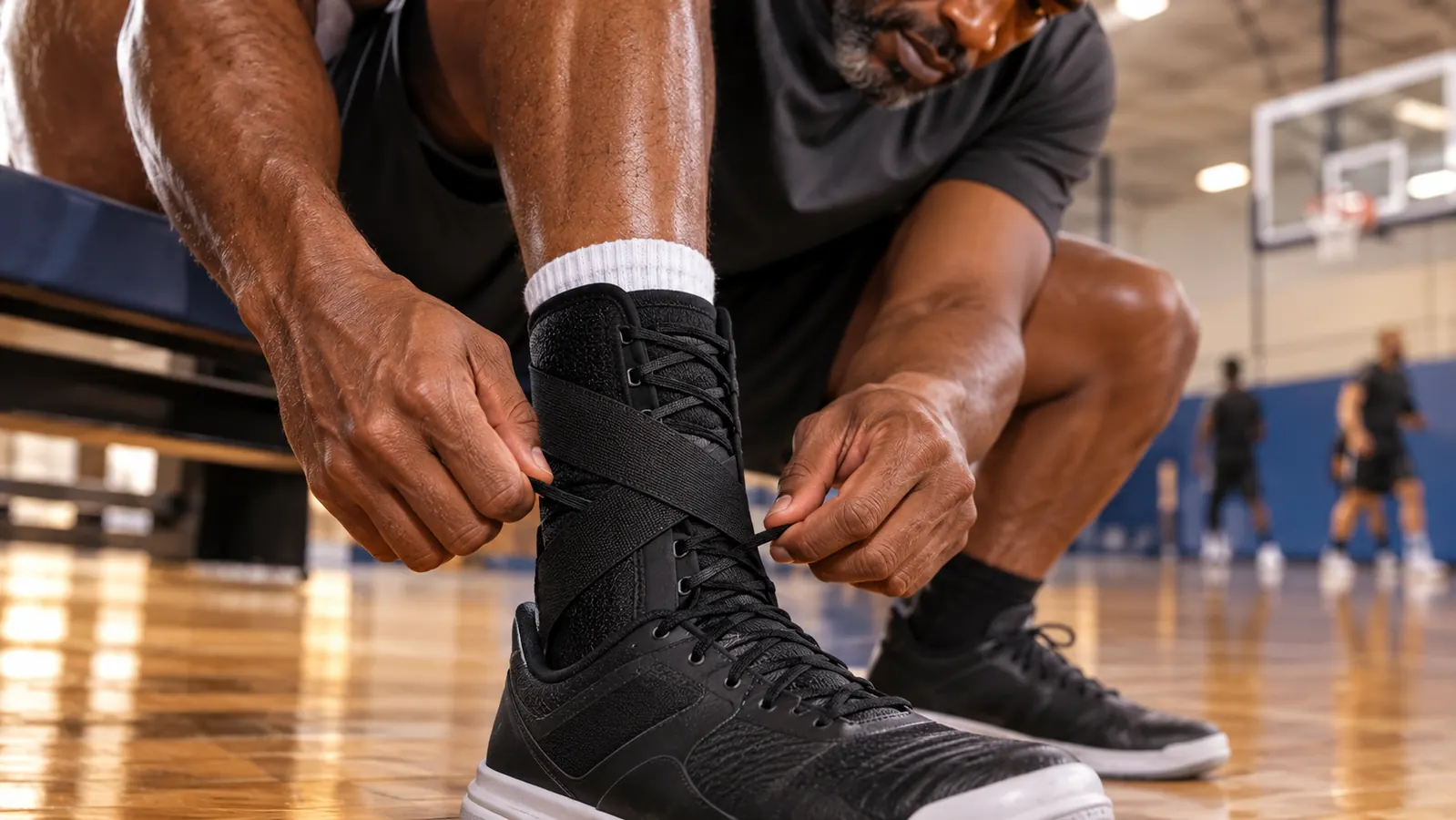
The McDavid brace is built around a figure 8 design that wraps across the top of the foot and back around the ankle, with rigid side stabilizers sitting on either side of the joint. The stabilizers are the point of the whole thing. They are what pushes back when the ankle starts to go over, and they are why the brace feels like a piece of equipment rather than an extra sock. There is an adjustable lacing system up the front and a hook and loop strap that closes over the top, so the compression is something you set on purpose instead of something you hope holds.
The trade is honest, and you should hear it up front. It takes about forty five seconds to put on properly, which is longer than pulling a sleeve over your foot. It is bulkier inside a shoe. And if you crank that strap down like you are trying to win an argument, the sides will dig into your ankle by the second quarter. I did that exactly once, on a Thursday, and spent the rest of the night thinking about my ankle instead of the game.
Step 2: Get the size right and give it a real fitting
I wear a men's 11.5 with a slightly wide forefoot and I went with a Large, which is the size listed. The brace weighs 3.2 ounces and measures about 9.2 by 7.5 by 4.2 inches, so it is not a small object and it will not vanish inside a tight shoe. That is a feature. You want to feel it sitting on your foot, because the whole reason it works is that it is doing something.
The fitting mistake I see guys make is judging the brace barefoot in the living room, then deciding it is either too tight or too loose based on five seconds of standing still. Put the McDavid on with the sock you actually play in. Put your shoe on over it. Walk around the house for twenty minutes on a day you are not playing. My first night with it I wore it through a grocery run and a load of laundry, which is a boring way to spend an evening and a much better way to find out that the stabilizers were sitting too high.
If your heel lifts out of the pocket when you walk, the lacing is not snug enough or the stabilizers are too high. If your toes go numb inside of fifteen minutes, it is too tight. Those are the two ends of the range, and everything in between them is personal. Give yourself a week of games before you decide it is wrong, because the first night always feels strange and the second night is when you learn anything.
Step 3: Put it on in the same order every single time
Order matters more than people expect. I seat the heel first, so the back of my heel is all the way down in the pocket. Then I line the side stabilizers up so they bracket the ankle bones instead of sitting on top of them, which pinches and feels like a mistake even when it is not doing damage. Then the laces, bottom to top, pulling each section snug as I go rather than yanking the top pair and hoping the rest follows along.
Then the strap, crossing in the figure 8 pattern, tensioned until the brace feels like a firm handshake. Same tension on a Tuesday as on a Sunday morning in the church gym. That consistency is why I trust the thing. A brace you tighten differently every night is a brace you cannot read, and when something feels off in the fourth game of the night, I want to know it is my legs talking and not my setup.
Eleven months of Tuesdays and Thursdays, plus Sunday mornings on a church gym floor slicker than the rec, and I have not rolled that ankle once.
The first two weeks I was slow at it, and I noticed. Now my hands do it while I am talking to somebody, which is the fairest test of any pregame routine. If it needs your full attention every time, you will skip it on the night you are running late, and the night you are running late is exactly the night you need it.
Step 4: Make it work inside the shoe you already own
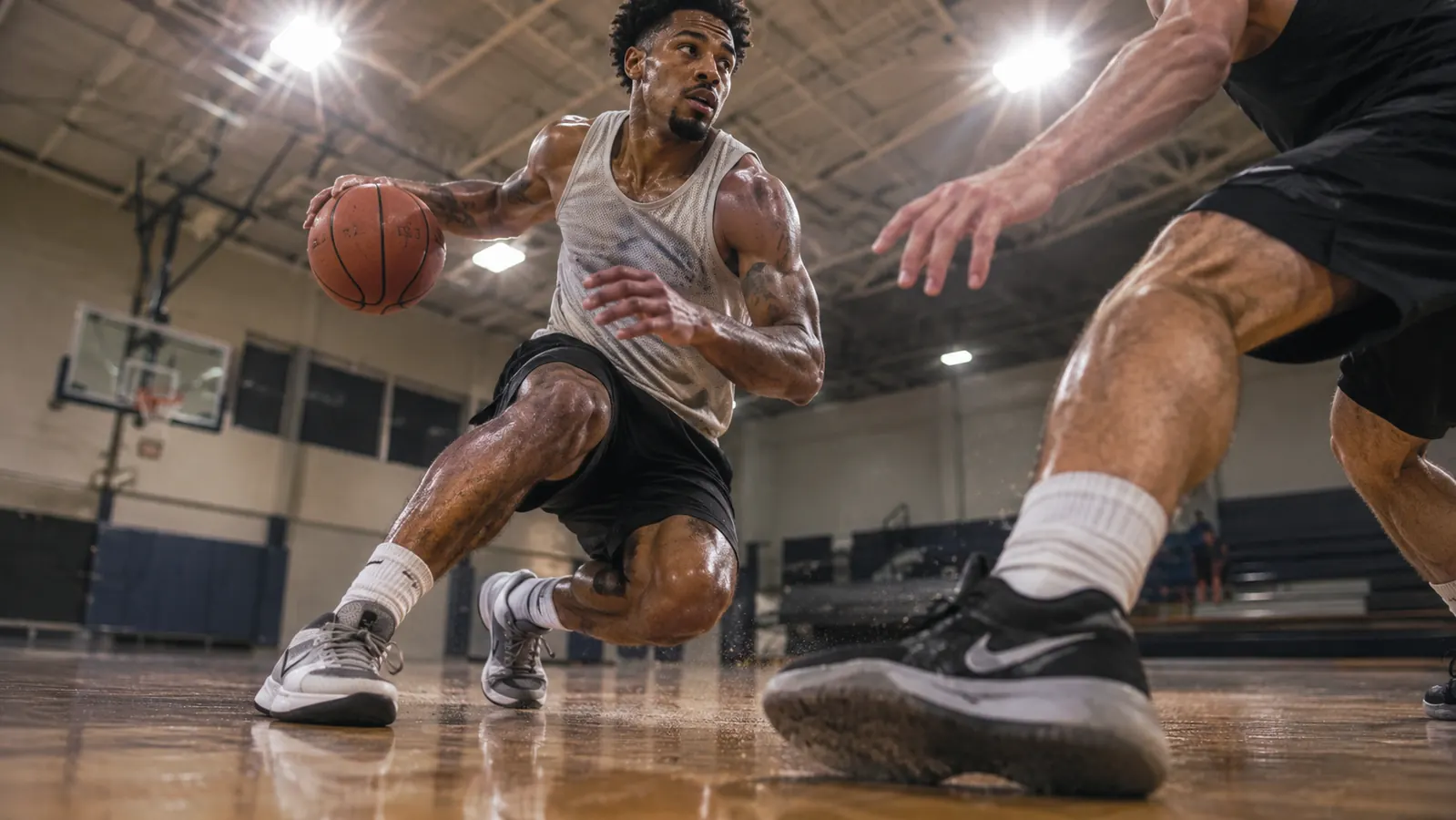
I rotate four shoes across the week. Under Armour Lockdown 7 on Tuesdays at the rec, adidas Own the Game 3.0 on Thursdays, the FitVille wide high-top on Sunday mornings for men's league, and the Nike LeBron Witness 8 as the spare and the summer outdoor shoe. The brace goes into all four. It changes the fit in all four, and in all four the answer was the same one: re-lace, do not re-buy.
When the McDavid goes on, your foot takes up more room through the midfoot. Loosen the laces two or three eyelets further down than you normally would and work back up from there, so the brace has somewhere to sit instead of mashing the top of your foot. On the wide high-top I barely notice the difference. On the Lockdown 7, which fits closer, I start one eyelet lower and leave the top pair a touch looser than I used to.
Do not go buy a half size bigger to make room for a brace. I have watched teammates do it and they end up with a shoe that is too long everywhere and still pinches across the instep. Fix the lacing, not the shoe. And check the heel of the shoe itself before you blame the brace, because a broken down heel counter will let your foot slide no matter what is wrapped around your ankle. When the back of a shoe has gone soft and lets your heel ride up, no brace on earth is going to cover for it.
Step 5: Wash it by hand and check the closure
The care instruction on the listing is hand wash only, and after eleven months I would not test that. The McDavid is polyester with a hook and loop closure, and neither of those enjoys a washing machine. I hand wash it in cool water with a little mild soap, rinse it out, and let it air dry flat, away from a radiator and nowhere near the dryer. It dries overnight. Do this every couple of weeks during the season, because a brace you wear three nights a week will get to a point where you can smell it from across the bench.
The closure is the part that ages first. Hook and loop picks up lint, fuzz and whatever lives at the bottom of a gym bag, and once it does, it holds a little less firmly. Check it every few weeks, pick the fuzz out with your fingers, and make sure the strap still lands flat when you close it. Mine still grips. The day it stops, I will replace it without a second thought, because a strap that lets go mid-cut is worse than no brace at all.
Beyond that, mine has held up. The laces have not stretched out, the stabilizers still sit where they are supposed to, and nothing has frayed. For a piece of gear that gets worn three nights a week and shoved into a bag in between, that is a reasonable run. I expected to be replacing it by now and I am not.
What Else Helps
The brace is not the whole answer and I would not want you to think it is. What it does is buy you the half second where your ankle would have gone over. What it does not do is make a weak ankle strong. So I do the unglamorous work twice a week: single leg balance work standing on the left foot for thirty seconds at a time, calf raises, and some banded work while I am watching television. It takes ten minutes and it is boring and it matters more than which shoe I laced up that night.
Landing mechanics are the other half. Most rolls happen because a guy comes down on one straight leg with all his weight and no give. Land with a little bend in the knee, land on the balls of your feet, and stop trying to come down on one foot in traffic when you do not have to. That is free and it protects more than your ankle. The McDavid brace has done exactly what I bought it for, and it would still not save me from a landing where I did everything wrong on purpose.
If you want the longer version of how this brace has held up over a full year, there is a long-term review on this site with the month by month notes. If you are still deciding between a brace and the sleeve you already own, there is a direct comparison of the two styles that lays out which job each one actually does. Both are worth ten minutes before you spend anything.
And one honest limit: I am a forty seven year old facilities manager who plays pickup three nights a week, not a trainer. If your ankle is swollen, unstable, or has been rolled twice in a season, go see somebody who can look at it properly. A brace supports a healthy joint. It does not fix an injured one, and it is not supposed to. I got lucky that my one bad roll was ten years ago and healed clean. Plenty of guys are not that lucky, and the brace is not a substitute for somebody telling you what is actually wrong.
One ankle, three nights a week, eleven months of not thinking about it
Size Large, 3.2 ounces, hand wash only, worn on the ankle that rolled ten years ago. It goes in every shoe in my rotation.
Amazon Check Today's Price on Amazon →