I bought the McDavid lace-up ankle brace in December 2025 because I got tired of pretending a compression sleeve was protecting me. About ten years ago I rolled my left ankle badly enough that I still think about it before every hard cut. For years after that I wore one of those pull-on sleeves that slides over your foot like a thick sock. It felt like insurance. It was more like a reminder. The night I ordered the McDavid, I was sitting on the edge of my bed rolling my ankle in slow circles and admitting to myself that fabric which stretches is not the same thing as support which stops a roll.
Eleven months later, that brace has been on my left ankle for every game I have played. Tuesday pickup in the Under Armour Lockdown 7. Thursday in the adidas Own the Game 3.0. Sunday morning men's league in the FitVille. And the LeBron Witness 8 when I get out to the park court in summer. I have not turned that ankle once in eleven months. That is the headline and I am not going to bury it. The rest of this review is the part I wish somebody had told me first, because the McDavid brace asks for something in return, and two of those asks will decide whether you actually keep wearing it past week three.
The Quick Verdict
Eleven months on my bad left ankle, zero rolls. The trade is shoe volume and about forty seconds of lacing before every game.
Amazon Check Today's Price →The brace that has kept my bad ankle quiet for eleven months
One Large, laced into every shoe in my rotation. Check the size chart against your shoe size before you order, then check today's price.
Amazon Check Today's Price on Amazon →What Nobody Tells You Before You Buy
Three things, and the first one is the reason people send it back. A lace-up brace adds volume inside your shoe. The McDavid is listed at 3.2 ounces, which is nothing in your hand. Weight was never the problem. What matters is that you are putting a layer of polyester and two rigid stabilizers between your sock and your shoe, across the top of your foot and around both sides of your ankle. The shoe that felt perfect last Tuesday now feels like it belongs to somebody else, and if you do not adjust for that, you will blame the brace for a fit problem you created.
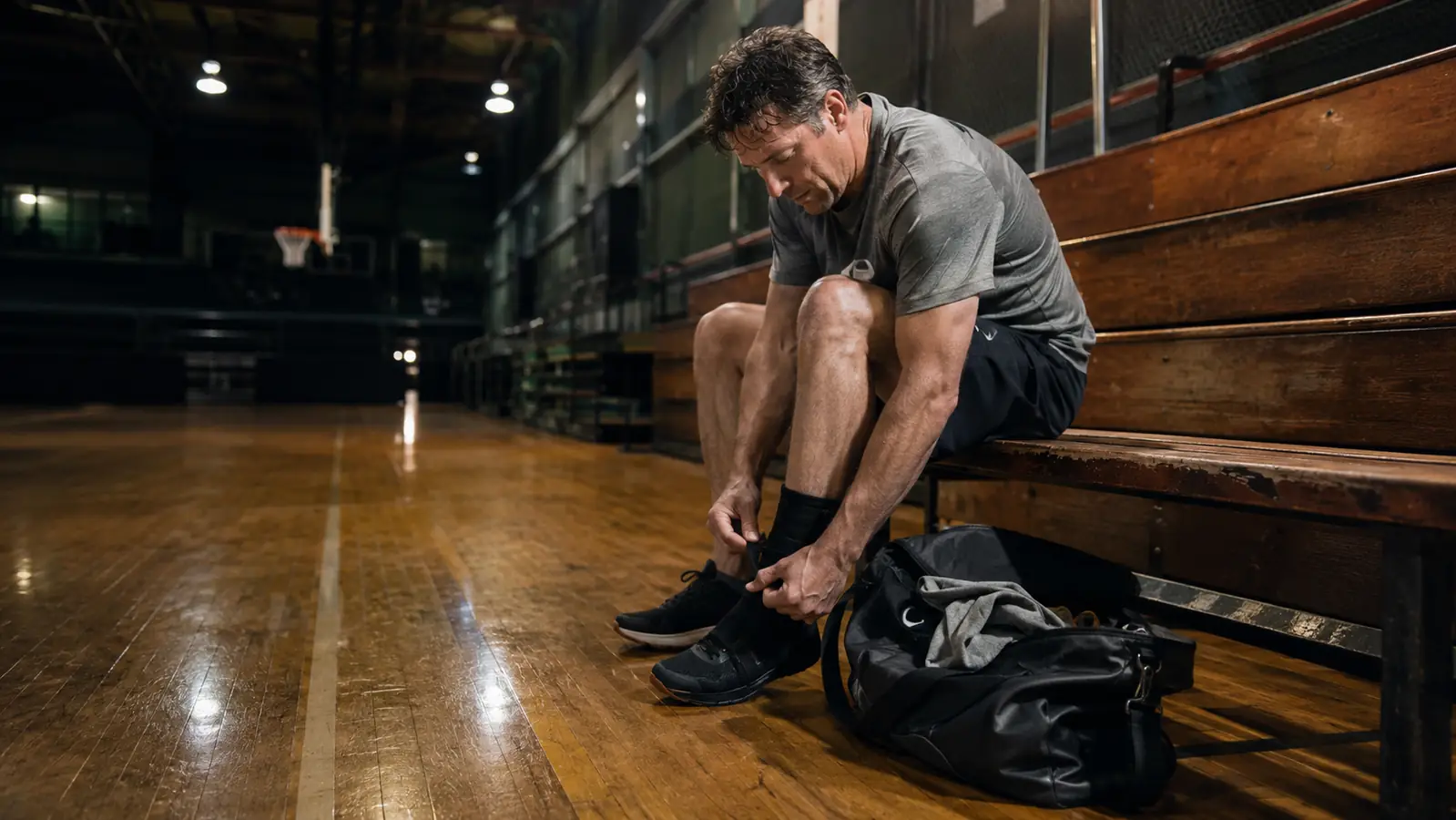
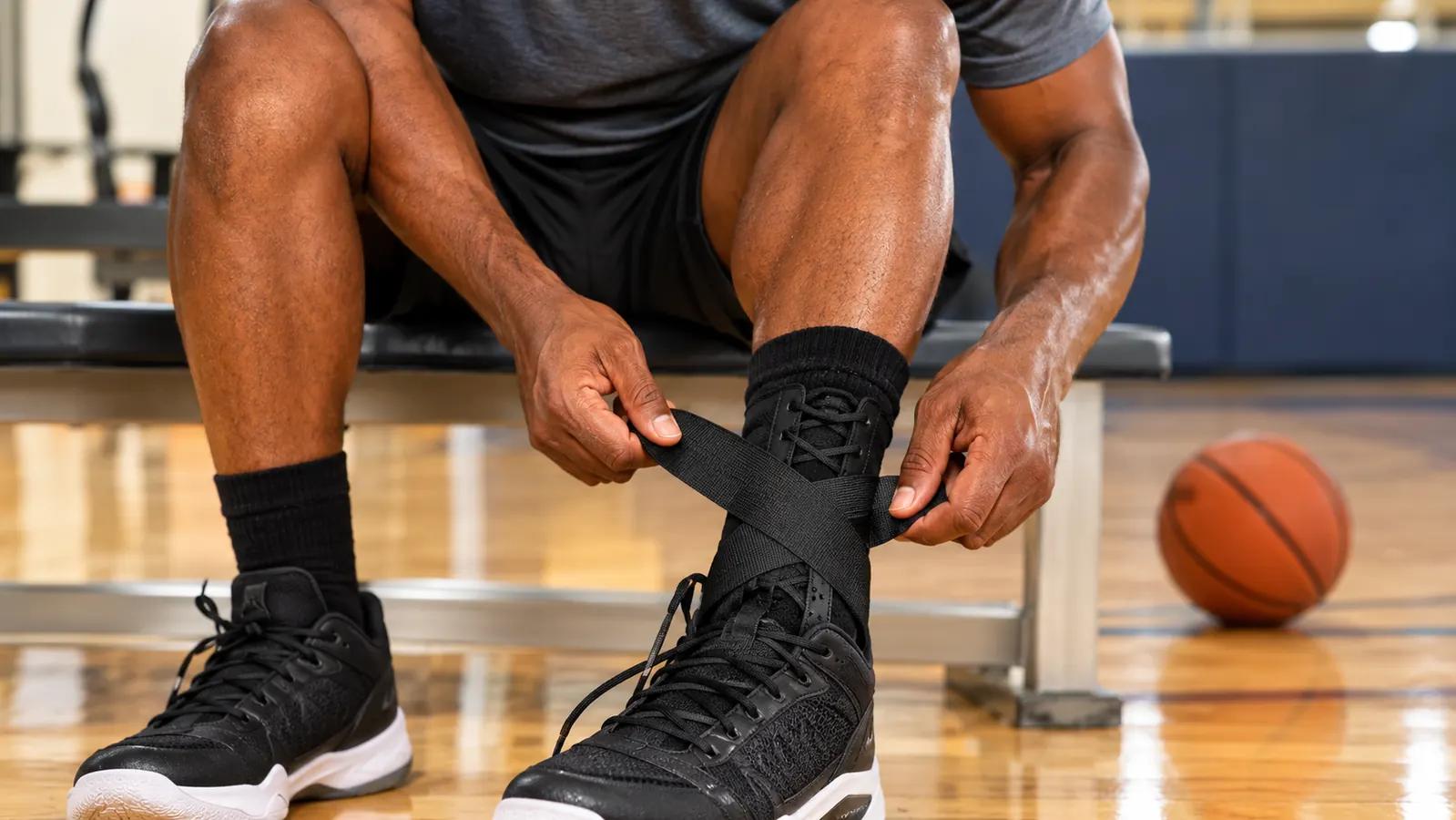
Second, it takes time. This is not a slip-on. There is a lace-up front, a figure 8 strap that wraps around and crosses over, and a hook and loop closure that finishes the job. My first week it took me a couple of minutes of fumbling in the dark. Now it is maybe forty seconds, and I do it sitting on the bench with the shoe waiting next to me. Forty seconds before every game for eleven months is a real cost, just a small one. If you are the guy who shows up three minutes before tip, you will feel it.
Third, and this is the one I care most about: the brace supports your ankle, it does not strengthen it. It will not fix a weak ankle any more than a knee sleeve fixes a bad knee. What it does is hold the joint in a sane position while you play. I learned that the hard way. For about a month after I retired the sleeve, I did nothing but wear the brace and assume I was covered. Then a teammate who had been through physical therapy pointed out that I could not stand on my left foot with my eyes closed for more than a few seconds. So I started doing single leg balances in the kitchen while the coffee brewed, thirty seconds a side, plus band work on Tuesday and Thursday mornings before work. That is unglamorous and it works, and the brace is what keeps me in the game while it does.
How I've Used It
Left ankle only. That was the ankle I hurt, and I saw no reason to brace the right one. The brace goes over a thin sock, the shoe goes over the brace, and then I lace the shoe looser through the middle than I would without it. It gets worn for pickup, for men's league, and for the occasional summer run at the park. I do not wear it to mow the lawn or walk the dog. It lives in my gym bag with a spare sock, and I hand wash it every couple of weeks because the care instructions ask for that and the material will let you know if you skip it.
The Sunday routine is its own thing. Church gym, two games back to back, and I put the brace on once before the first game and leave it on through the second, including the twenty minutes between them when I am sitting on the bleachers drinking water. It does not loosen enough to matter. That is worth knowing if you play multiple games in a night: you lace once, and you check the strap at halftime out of habit rather than need.
The first two weeks were the awkward ones. The material was stiff and I could feel the top edge against the front of my ankle when I got low in a defensive stance. That softened up. By week three I stopped noticing it during play and only noticed it when I took my shoe off, which is exactly what you want from a brace. If you are expecting it to feel like nothing from day one, you will be disappointed for about ten days and then you will forget you were disappointed.
The other thing about wearing it every game is that it changed how I think about shoe room. The FitVille extra-wide high-top I wear on Sundays handles the brace best, and that pair predates the brace by a few months, so I got lucky rather than smart. My snug shoes now feel snug plus one. That is not a flaw in the brace, but it is a downstream effect that the listing never mentions, and it matters more than the 3.2 ounces does.
Eleven months, roughly twice a week plus Sunday league, and my left ankle has not turned over once. Everything else in this review is a trade-off, and I would make the trade again.
The Shoe Fit Problem, In Detail
Here is the practical version. Between the brace and your foot you want a thin sock, not a cushioned crew. Cushion plus brace plus shoe is how you end up with a numb forefoot in the second half. I use a thin sock in every shoe now, and I keep two pairs in the bag so a damp one never forces me into a thick one.
In the Lockdown 7, which is a fairly roomy shoe on my foot, I had to loosen the laces two rows down from the top and re-tie looser overall. Same story in the Own the Game 3.0. In the FitVille extra-wide, barely any adjustment at all. In the LeBron Witness 8, which mostly lives outdoors in summer, I go a notch looser and it is fine. None of this is difficult. All of it is a decision you make once and then repeat every single game.
I checked the volume difference out of curiosity one night, mostly because my left shoe stopped feeling like my right one. With the brace on, the left foot needs noticeably more room through the midfoot than the right does. That is why the looser lacing is not optional for me, and it is why I now tug my laces at the first dead ball instead of waiting until something feels wrong. It took me a couple of games to build that habit, and the games where I forgot were the ones where my forefoot went numb by the second half.
The pattern I would hand to anybody: if your game shoes already fit snug, expect to loosen them. If they fit with a little room to spare, expect to notice the brace for a week and then forget it is there. If they fit tight and you love that feeling, this brace will annoy you, and no amount of break-in is going to change that. That is not a knock on the product. It is just the shape of the thing.
What the Support Actually Feels Like
It does not feel like compression. A sleeve squeezes evenly and tells you it is there. This is more like a shell with two stiff panels sitting on the outside of your ankle bone, connected by laces across the front and a strap that wraps and crosses. When you push off to the left, you feel the outside panel stop the joint from continuing to travel. That resistance is the entire point, and it is the reason I stopped wearing the sleeve.
The clearest demonstration came on a Thursday night in February. I came down on somebody's foot after a rebound, felt the ankle start to go, and the outside panel caught it well before the joint reached the angle that scared me ten years ago. I felt a stop, not a snap. I stayed on my feet, finished the run, and drove home with the ankle quiet. That is the whole case for this thing, and no listing copy is going to make it for you the way one bad landing will.
The range of motion you keep is decent. I can still get low, I can still backpedal, I can still plant and go. What I gave up is the last few degrees of roll at the end of a bad landing, which is precisely the range where I got hurt ten years ago. If your sport needs that last bit of freedom, this is not the brace for that. For basketball, where the injury happens on a landing or a cut, I will pay that toll every game.
One honest note on the side stabilizers: they are rigid, and rigid means they press. The first week, the panel on the outside of my ankle left a red mark after a hard run. Not painful, just noticeable. It faded as the material softened and as I figured out strap tension. Which brings up the thing nobody tells you about figure 8 straps: too loose and you get no support, too tight and your foot goes numb. You will spend a week or two dialing that in.
What I Liked
- Keeps a previously sprained left ankle stable through cuts and landings, eleven months without a roll
- Figure 8 strap and rigid side stabilizers give real resistance, not just a squeeze
- Light enough at 3.2 ounces that I forget about it mid-game
- Fits inside every shoe in my rotation once I loosen the laces a couple of rows
- Adjustable lacing and hook and loop closure let me set the tension myself
Where It Falls Short
- Adds enough volume that snug shoes need loosening
- Roughly forty seconds of lacing before every game
- Rigid side panels pressed on my ankle bone for the first week
- Hand wash only, and polyester holds odor if you skip it
- Does nothing to strengthen the ankle, so the band work is still on you
The Stuff That Bugged Me
Hand wash only is a real instruction and I follow it, but polyester against skin twice a week for eleven months develops a smell that cold water and a little soap barely stay ahead of. Plan for that. I wash mine every other week in the sink, wring it out in a towel, and let it air dry overnight. If you throw it in the machine because you are in a hurry, you are rolling the dice on the hook and loop and on the strap keeping its shape.
Speaking of the hook and loop closure, it collects lint and hair like it is being paid to. I pick it clean every few weeks or it stops gripping as sharply. Normal for the material, not a defect, but it is maintenance, and maintenance is the thing people quit doing around month four.
Sizing deserves its own note. Mine is a Large, and I wear a men's 11.5 with a slightly wide forefoot. Large works for me with room left on the strap. What I would not do is guess. Check your shoe size against the chart on the listing instead of assuming Large means what it means on a t-shirt. Getting this wrong is the most common way people end up with a brace that either will not stay put or cuts off circulation, and then they leave a one star review about the wrong size.
The brace is also not subtle. It is a visible piece of equipment on your ankle, and if you wear low socks it will show. I stopped caring about that around week two. If you are the type who cares, and plenty of guys are, know going in that this is not a discreet little sleeve. It looks like what it is, which is gear doing a job.
Who This Is For
Grown adults who play a sport with cutting and landing, who have already sprained an ankle at least once, and who want mechanical support rather than a snug feeling. Rec basketball, men's league, soccer, volleyball, tennis, anything that sends you sideways. It is also for the parent buying for a teen player, with two caveats: get the size right, and understand that a kid who will not do the balance work is still at risk. My son Jalen plays JV, and I have looked at this brace for him more than once.
It is also for the player whose ankle feels fine on a Tuesday and then rolls on a Thursday for no reason at all. That was me. The brace does not make you stronger, but it makes the bad landing less punishing, and for a 47 year old with a day job and a facilities budget to manage, less punishing is the whole goal. I do not need to jump higher. I need to walk into work on Friday.
Who Should Skip It
Skip it if you want something you can pull on in three seconds. Skip it if your shoes fit tight and you love that. Skip it if you are dealing with an active injury right now, because this is not a medical device and it is not a substitute for a doctor or a physical therapist. And skip it if you are buying it instead of doing the balance and band work, because a brace holding a weak ankle is still a weak ankle, just with better equipment around it.
Also skip it if you have had a fracture or surgery and have not been cleared for this kind of support, or if a rigid panel on the outside of your ankle would get in the way of what you do. I am a facilities manager who plays pickup, not a clinician. What I can tell you is what eleven months on my own ankle felt like. What I cannot tell you is what your ankle needs. Those are different questions and only one of them is mine.
Eleven months, one sprained ankle, zero rolls since
Large, thin sock, laces loosened a couple of rows. That is the whole setup. Check the size chart against your shoe size, then check today's price.
Amazon Check Today's Price on Amazon →