I bought the FitVille Wide Basketball Shoes because a standard-width shoe was quietly ruining the last twenty minutes of my Sunday games. Not in a dramatic way. No blister, no pop, nothing you could point at. Just a slow squeeze across the ball of my foot that showed up in the second game and made me want to sit down.
That was September 2025. I am 47, six foot one, about 205 pounds, and I play guard and wing at a church gym on Sunday mornings, two games back to back. I wear a men's 11.5 with a slightly wide forefoot. I have been in the FitVille extra wide high-top roughly once a week since, so about fourteen months at this point, and it is still in one piece and still in the rotation. This is the part where most reviews tell you it changed their life. Mine did not. It solved one specific problem very well and asked me to accept two others, and you should hear about all three before you spend anything.
The Quick Verdict
A genuinely wide, genuinely supportive high-top for adult rec players whose forefoot has been getting pinched. Heavy, slow to break in, and not a shoe for a quick guard who lives on his toes.
Amazon Check Today's Price →If your forefoot has been pinched for years, start by checking what the extra wide actually costs today
FitVille builds this one in widths most basketball shoes skip entirely. Check the current listing, confirm the width you need, and read the sizing note before you order.
Amazon Check Today's Price on Amazon →What Nobody Tells You Before You Buy a Wide Basketball Shoe
Here is the thing about shopping for a wide basketball shoe in 2026: almost nobody makes one, so the few that exist get reviewed like they are all the same. They are not. A wide shoe can be wide in the forefoot and narrow in the midfoot, or wide everywhere and sloppy as a result, or wide but built on a last that still fights your arch.
The FitVille is wide in the place I actually needed it, which is across the ball of the foot and out toward the small toes. That is the whole reason I bought it and the whole reason I still wear it. But a wide shoe does not automatically become a good basketball shoe, and the honest version of this review has to separate the width from the basketball.
So that is how I am going to lay it out. Where the width holds up, where the shoe behaves like a real high-top on a cut, and where it makes you pay for both. I have no sponsorship, no free pair, and no reason to soften it.
How I've Used It, and What I'm Comparing It To
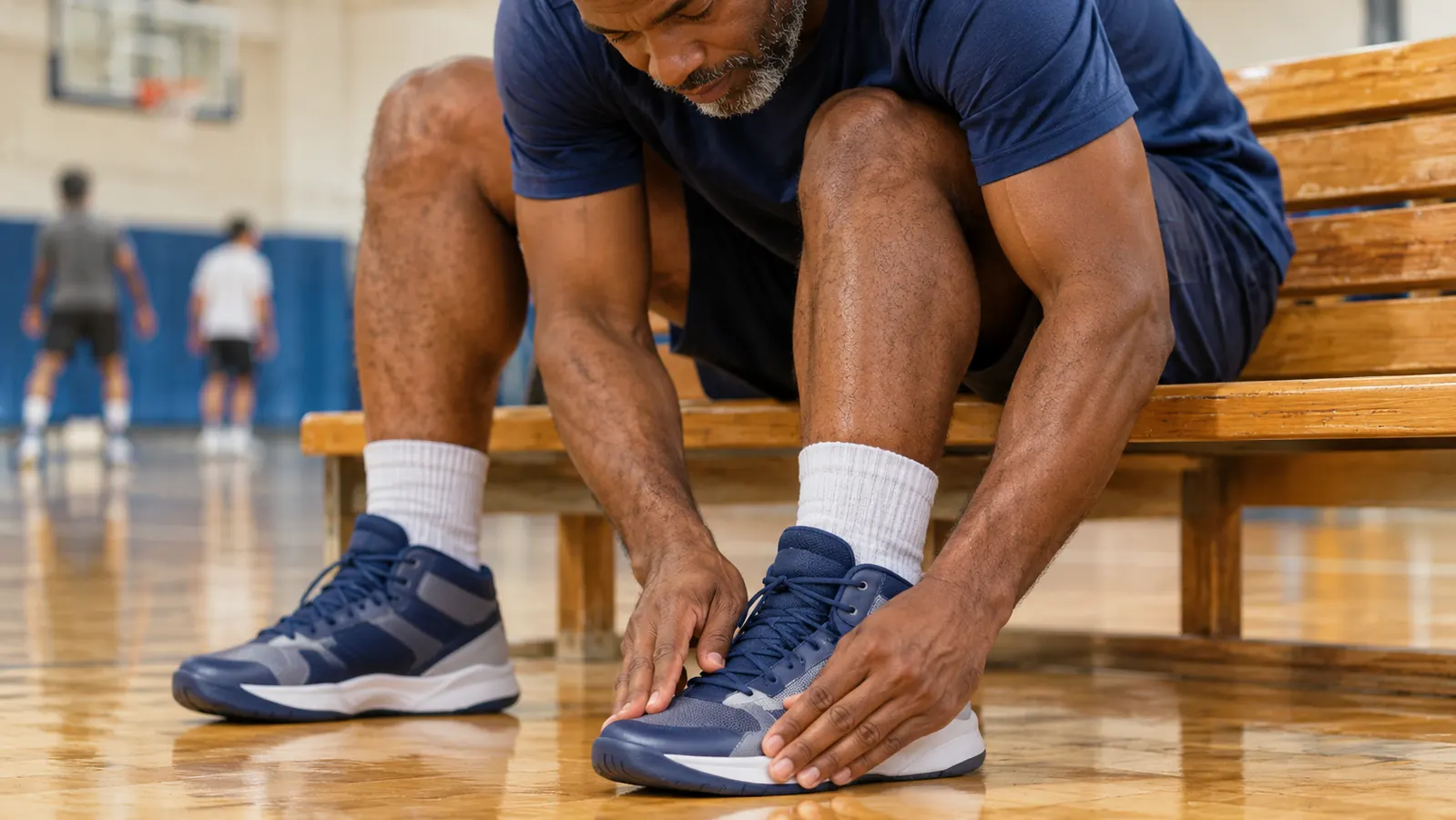
One pair, men's 11.5 extra wide, indoor hardwood only. My Sunday morning men's league runs two games back to back in a church gym, and the floor there is not pristine. It gets dusty by the second game, especially in winter when the doors stay shut. I have not used the FitVille outdoors. My outdoor summer shoe is a different pair entirely, and I would not volunteer this one for asphalt.
Before I ordered anything, I spent a Saturday afternoon in late August driving to two sporting goods stores and trying on every wide court shoe they had on the shelf, which between them was three. All three were roomy across the ball of the foot, which was the point. Two of them came up no higher than my ankle bone, so they did nothing for the thing I care about most. The third had the height but let my heel lift when I pushed off in the store aisle, and I could feel it would only get worse once it broke in. I went home and ordered the FitVille that night. That is not a knock on those shoes. It is just how short the list is when you need wide and high and stable in the same shoe.
For context on my own feet: I rolled my left ankle badly about ten years ago, and I have cared about ankle support ever since. I wear a lace-up ankle brace on that left ankle in every game, inside whatever shoe I am wearing. So when I talk about how a high-top holds, I am talking about a shoe with a brace inside it, and I will say so every time it matters.
I also rotate three other shoes through the week, which is the only reason I can tell you anything useful about the FitVille. My Tuesday pickup shoe and my Thursday pickup shoe are both standard width, and the contrast is where the real information lives. When you wear one shoe for everything, you stop noticing what it does to you.
The Fit: Where It Genuinely Wins
The forefoot room is not marketing. It is the reason to buy this shoe. My toes spread out flat when I land instead of curling under, and that changes how the whole game feels in the second hour. In my standard-width shoes, by the fourth game of the week my feet are talking to me. In the FitVille on Sunday, they are not.
The other thing I did not expect: the width did not turn into slop. Plenty of wide shoes feel like a paper bag once you get them on, with your foot sliding around inside. This one holds across the top of the foot once the laces are pulled, and my heel stays put. That is a real design achievement and I do not say it lightly, because I have tried wide shoes that felt like wearing a grocery sack.
I did a crude check the first night I had them, sitting on the edge of my bed with the laces slack. I pressed my thumb down across the ball of my foot, right where the squeeze used to start, and the upper gave instead of my foot. Then I pushed off the floor with the heel and it stayed in the shoe. I have run that same check every few months since. Fourteen months in, the upper has softened with wear but it has not stretched into a slipper, and the heel still stays put. That second part is the one that surprises me, because most wide shoes I have worn get looser and lazier with time rather than more honest.
The lacing goes where it needs to go. It is a lace-up with a closed toe, and the upper takes tension evenly rather than pinching in one spot. If you have a high instep, which I do mildly, that matters more than any spec sheet will tell you.
My toes spread out flat when I land instead of curling under. That is the entire reason this shoe is still in my bag fourteen months later.
The Support: A Real High-Top, With a Catch
I want to be careful here, because ankle support is the thing people buy a high-top for and the thing reviews lie about most. The FitVille collar comes up above the ankle bone and it does hold. On a hard cut to my left, the side I worry about, the shoe resists before my ankle does. That is the job. It is not the same as a brace, and I would not wear it as one, but it does real work.
The catch is that a high collar and a wide forefoot together make a stiff shoe. It took me about three weeks of twice-a-week wear before the collar stopped pressing on the front of my ankle when I crouched into a defensive stance. It was not painful, just noticeable, and I spent a couple of games tugging at the tongue. Then it settled and has not come back.
The cushioning is moderate to high, and the insole is a foam insole. That is good news for a 205 pound player on a hardwood floor, and it is the other reason my feet are fresher after two games than they used to be. But do not mistake that for a soft ride. The shoe is firm underfoot and it wants you to feel the floor, which for a bigger rec player is the right call and for a lighter player might feel harsh.
Where This Shoe Quietly Costs You
Weight. Nobody puts this in a spec sheet in a way you can feel, so let me put it in plain words: the FitVille is a heavy shoe. Not unwearable, not a boot, but heavier than anything else in my rotation. In the first game I do not notice. In the second game, late, when I am trying to stay in front of a 25 year old who has been resting, I notice.
I can put a date on that. Mid February, second game of the morning, one of the younger guys in our league kept working the baseline on me. Nothing tricky, just a hard first step and a re-cut. In my Thursday shoe I get that stop maybe one time in three. That morning I got it once, and the other two times I was a half step late and reaching. My feet were fine. My legs were fine. The shoe was just not fast, and at 47 against a 25 year old you do not get to give away a half step for free.
Lateral quickness. This is the tradeoff that comes with the width and the high collar and the firm build, and it is the one I would want to know about before buying. If you are a guard who lives on hard lateral slides and crossovers, this shoe is not going to feel like an extension of your foot. It feels like a shoe. A good, stable, roomy shoe, but a shoe.
Break-in. Three weeks is not nothing. If you are buying this the week before a season starts, plan to wear it around the house and to a couple of shootarounds first. Going straight into two competitive games in a fresh pair is how you end up with a sore spot on the front of your ankle and a bad opinion of a decent shoe.
Water resistance is listed as not water resistant, which is honest and worth knowing if you play in a gym where the roof leaks or you walk to the car through a wet parking lot. It is an indoor shoe. Treat it like one.
Durability After Fourteen Months
Here is what fourteen months of weekly indoor play looks like on these. The upper is intact. No separation where the sole meets the upper, no split seams, no lace eyelet pulled through. The collar padding has compressed a little, which every high-top does, and it still holds my ankle brace the way it did in month two.
I gave the whole shoe a slow look in June 2026, sitting in the parking lot after league let out, mostly to decide whether I needed a second pair for the fall. What I found was the kind of wear you want: a crease across the top of the toe box where my foot flexes when I run, and a rubbed spot on the inside of the collar where it meets my brace strap. Nothing torn, nothing lifting, nothing that made me think twice about wearing them the next Sunday. The only thing that looked tired was the inside. The foam insole had packed down under the ball of my foot and I could feel the difference underfoot compared to the fall before.
The cushioning has flattened some. Not dead, but the shoe underfoot is a little more honest about the floor than it was in the fall of 2025. That is normal for foam after a year of Sundays, and it is the first thing I would expect to go.
Grip on my church gym floor has held up better than I expected for a dusty court. I wipe the bottom of the shoe with my hand before the second game, I keep it in my bag and indoors, and it still bites on a cut. I have not punished it on asphalt, so I cannot tell you how it handles that, and I would rather say so than guess.
What I Liked
- Real extra-wide forefoot room that does not turn sloppy once the laces are tight
- The high collar genuinely resists on a hard cut, which matters if you have had an ankle scare
- Moderate to high cushioning with a foam insole keeps a 205 pound player comfortable for two straight games
- Upper, seams and eyelets all still intact after fourteen months of weekly indoor play
- Lacing takes tension evenly across the top of the foot, including a mildly high instep
Where It Falls Short
- Heavy compared to a standard-width guard shoe, and you feel it late in the second game
- About three weeks of break-in before the collar stops pressing the front of the ankle
- Slow laterally, so quick guards will fight it on defense
- Listed as not water resistant, so it is strictly an indoor shoe
- The foam insole packs down after a year and the ride gets firmer
Who This Shoe Is Actually For
If you are an adult rec player with a wide forefoot who has spent years buying standard-width basketball shoes and paying for it in the second hour, this is the shoe. That is the customer FitVille built it for and it delivers. Same if you have flat feet and find most athletic shoes put pressure in the wrong place across the arch. The room is real and it is where you need it.
It also suits the bigger, slower, more grounded player. If your game is positioning, rebounding, setting screens, and defending with your feet rather than your hops, the stability and the cushioning will help you more than the weight will hurt you. I would put a 250 pound rec center center in this shoe without hesitation.
And it makes sense for the player who has had an ankle scare and wants a high collar without going to a brace. It is not a substitute for a brace, and I would still tell you to see someone about a bad ankle. But it is a legitimate step up from a low-cut shoe.
Who Should Skip It
If you are a quick, light guard who plays on your toes and lives for the first step, skip it. The weight and the stiff build will frustrate you and you will blame the shoe for something it never claimed to be. There are lighter options and you should go find them.
If you need a shoe you can play in tomorrow, skip it. The break-in is real and a fresh pair on game day is a bad plan.
If you play mostly outdoors on asphalt, I would be careful. Nothing about this shoe says outdoor durability to me, and the listing is upfront that it is not water resistant. It is an indoor hardwood shoe and I would keep it there.
And if you have a normal-width foot with no complaints, there is no reason to buy a wide shoe. You would be taking on weight and stiffness in exchange for room you do not need.
What I'd Tell You If We Were Sitting on the Bench
Buy it for the width and the collar, not for the basketball. That sounds like faint praise and it is not. For a certain kind of rec player, the width and the collar are the basketball, because you cannot play well in a shoe that hurts.
Give it three weeks before you decide. Wear it around the house, shoot in it, then play. If the collar is still pressing on your ankle after three weeks of real use, it is the wrong shoe for your foot and you should return it, which is exactly what the return window is for.
Keep it indoors, wipe the bottom before the second game, and put your brace on. The shoe does its part. It will not do yours.
Fourteen months in, my Sunday shoe is still this one. Check the extra wide sizing before the season starts
Confirm the width, plan for a break-in period, and keep it on hardwood. If your forefoot has been the problem all along, this is the fix.
Amazon See the FitVille Wide Basketball Shoe on Amazon →